Through the Focused Ed professional development program, I attended three fantastic webinars on Friday, February 13th.
Student AI Literacy Lessons K-12
NFB K-12: More than Just Great Canadian Films!
I Am Because We Are: Grade 6-9 Black Canadian Learning Resource
I’m really glad we had this experience. I learned a lot and added a bunch of resources to my future teacher toolkit.
I feel like I’ve written boatloads about AI already in my weekly reflections. I found the Student AI Literacy webinar helpful and interesting, and I will absolutely be borrowing their PowerPoint-based lessons about what artificial intelligence is, its environmental impact, and how students can use it safely. However, I want to focus this week’s reflection on something that was totally new to me – “I Am Because We Are,” the Black Canadian Learning Resource tailored to Grade 6-9.
I Am Because We Are: Black Canadian Learning Resource (Grade 6-9)
Video overview of the “I Am Because We Are” learning resource
I learned so much from this webinar. At first, I was apprehensive about how the instructor was a white woman like me, but she was so knowledgable and respectful and acknowledged her positionality. This actually made me feel better about teaching topics that are outside of my personal experience.
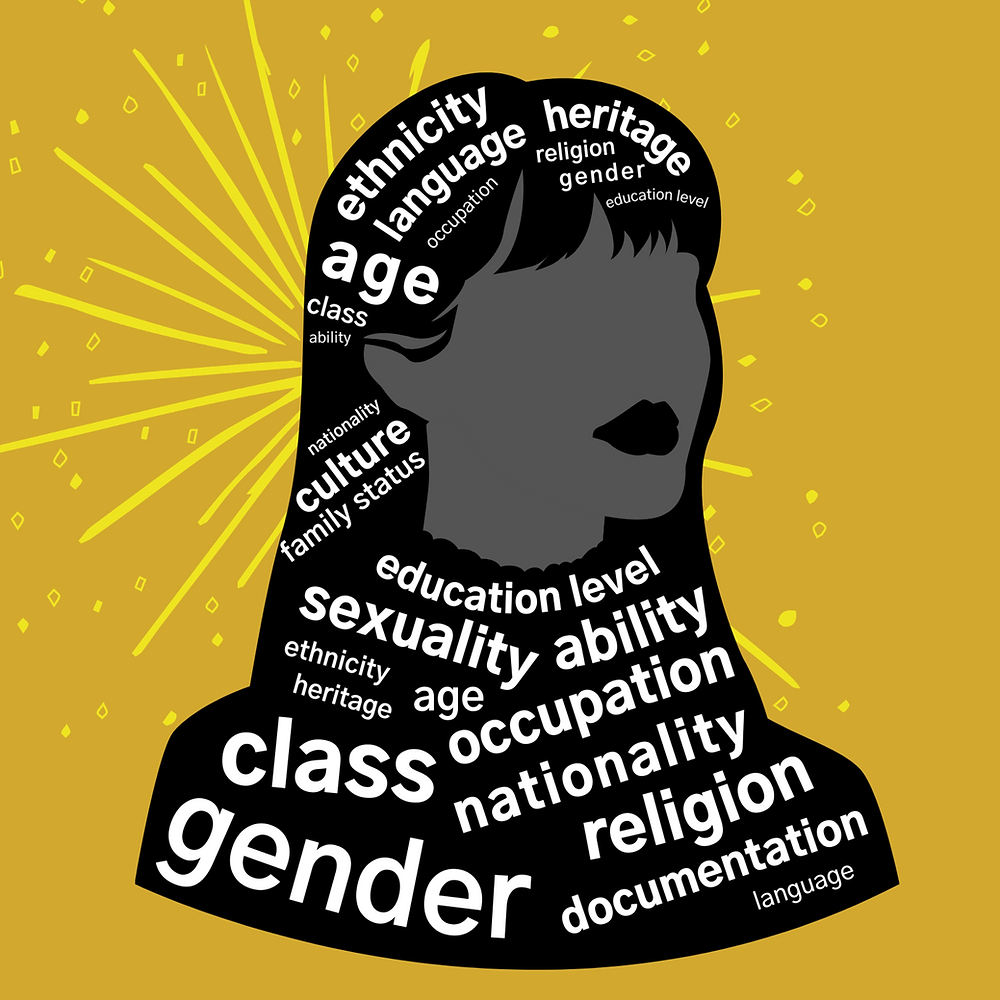
Visual depiction of positionality (created by WISE – the Women’s Initiative for Self Empowerment). I am a white, cisgender, straight woman from a middle-class background, and all of these aspects of my identity inform my perspective and can affect the way I view my students and teach, even subconsciously – that’s why I think it is important to consider our positionality.
I want to teach upper elementary or middle school, so I was immediately interested in this program because it is designed for my target grades. I will absolutely incorporate “I Am Because We Are” into my teaching.
When I was in school, we learned little about the history of Black Canadians except for stories of suffering (e.g., transatlantic slave trade, reading books about the Underground Railroad) and one-off stories of individual success (I remember learning a little bit about Viola Desmond). I like “I Am Because We Are” because it doesn’t do that at all! It tackles important and heavy topics like erasure of Black Canadians from history, but it also highlights heroes and rebellions, Black joy, Black identity, and Black excellence. Here are the 7 topics covered in the program (it’s recommended that these are completed in order).
Ubuntu Philosophy
Black Joy
African Diaspora
Heroes and Rebellions
Erasure
Black Identity
Black Excellence
Isn’t that cool how Black joy is talked about right away, rather than as an afterthought?
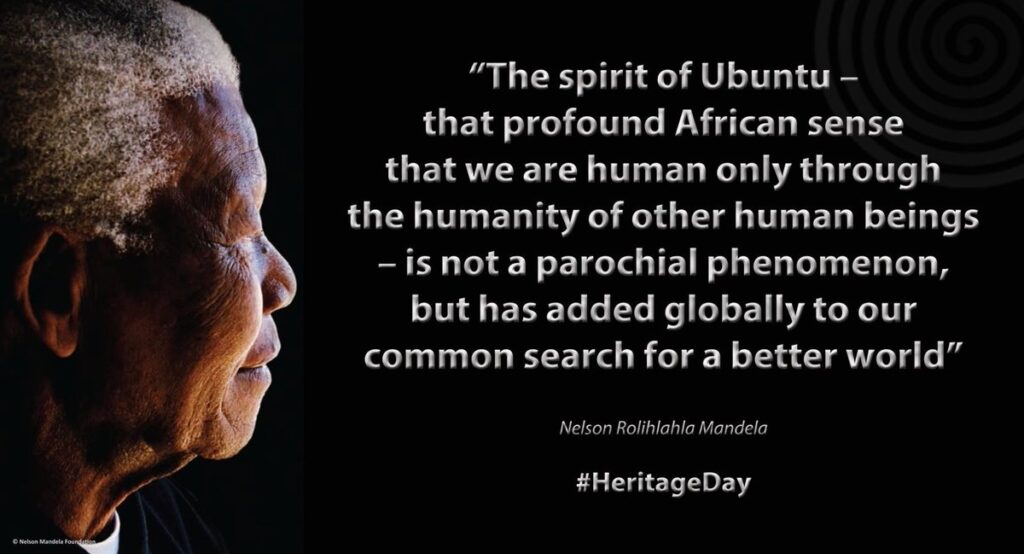
I also knew next to nothing about Ubuntu principles. I learned that Ubuntu is an African philosophy that emphasizes values like interconnectedness, compassion, respect, and harmony. The crux of Ubuntu is “I am because we are”- it’s about understanding oneself in the context of others. Another cool thing about this Focused Ed resource is that it intertwines Ubuntu principles with the First People’s Principles of Learning.
Quote by Nelson Mandela about Ubuntu (source). I had to look up “parochial” – it means having a narrow outlook or scope. So, in this context, Mandela was saying that the idea of Ubuntu comes from Africa but is applicable everywhere.
“I Am Because We Are” is a fantastic resource for Canadian students of all backgrounds. Our prof Roz Stooke, who teaches our reading class, showed us a powerful quote that reminds me of the importance of programs like these:
Children need texts that are mirrors and texts that are windows.
For my students who are Black, these lessons would be validating – they would act as mirrors where they could see themselves and their history reflected and appreciated. I think that “mirrors” are all about representation and seeing oneself as an important part of history and the world today. For my students who are not Black, “I Am Because We Are” would act as an important window into the perspectives and experiences of others.
Hej! Hur mår du? Jag mår bra. (Hi! How are you? I’m good).
I haven’t made an inquiry blog post for a while, but that doesn’t mean I haven’t been busy inquiring into Swedish language and culture. I’m approaching a month into my language learning journey – I just notched my 25th day of Duolingo. I’ve been aiming for one mini lesson a day, which takes me around 5 minutes. I’m definitely making progress, but slowly.
Screenshot
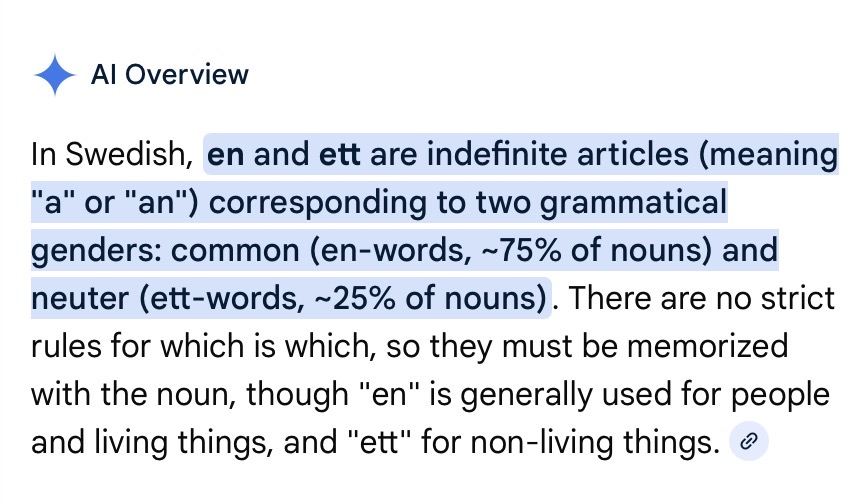
Duolingo’s approach is interesting in that it teaches individual words and phrases, but no grammar. I find myself wondering about syntax a lot… for example, I’ve gathered that sometimes, the “a” before a noun in Swedish is “en,” and other times, it’s “ett.” I couldn’t figure out the pattern, so I looked it up. And turns out, there isn’t much of a pattern at all. Unlike in English, where “a” precedes a word starting with a consonant and “an” precedes a vowel, Swedish speakers have to memorize when to use each version. “En” is more common (which I’d already gathered from seeing it pop up frequently in my Duolingo lessons), and “ett” is only used 25% of the time. Often, “ett” belongs with non-living things and “en” with living things, like “en hund” (a dog).
AI overview for the search query, “difference between en and ett in Swedish”
Thanks, AI overview!
I’ve noticed that Duolingo’s approach to teaching languages seems to rely on users gradually picking up words and phrases and filling in the blanks using pattern recognition. There’s no explicit teaching, which honestly, I might appreciate. I would love to learn how Swedish works phonetically, like, What is the difference between a, ä, and å in terms of sounding out a word? I think some knowledge of the phonemes that make up the Swedish language could be helpful as I approach unfamiliar words like place names (e.g., I don’t want to embarrass myself by majorly mispronouncing someone’s hometown or the name of a train station I’m trying to get to).
New words and phrases unlocked
Sverige = Sweden
Min man = my husband
Min fru = my wife
En hund = a dog
Lång = tall
Rolig = funny
Smärt = smart (duh!)
Snäll = nice
Från = from
Hur mår du? = How are you?
God kväll! = Good evening!
Vi ses! = See you!
Bra = good
So now, I can say, “My husband from Sweden is tall and funny!” Min man från Sverige är rolig och lång! Just kidding, I do not have a husband from Sweden (Yet! Growth mindset!).
Plus: Following Team Sverige in the Winter Olympics
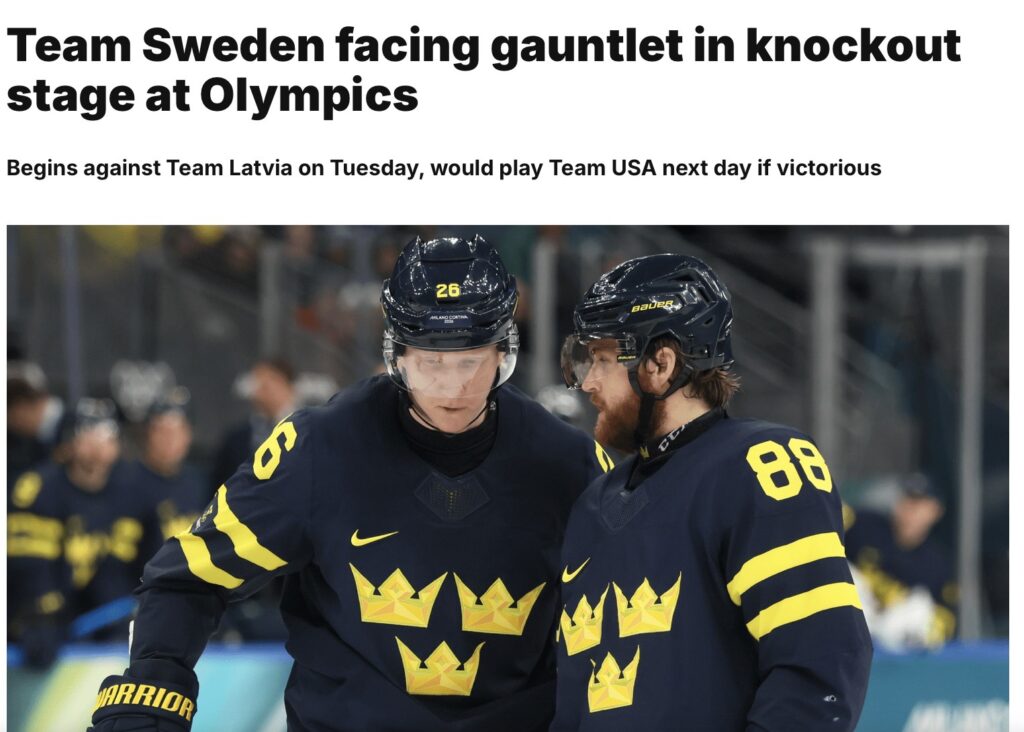
The Swedish men’s hockey team plays their first elimination game of the 2026 Olympics on Tuesday and I’m planning on tuning in! They take on Latvia, and the winner will face tough competition in the quarterfinal – the #2 seeded Americans.
According to The Player’s Tribune (I found this great article written by NHL player Victor Hedman), ice hockey is a cornerstone of Swedish culture. It is deeply woven into the national identity and Sweden has a reputation for producing top-tier NHL players. I grew up in Vancouver idolising Daniel and Henrik Sedin and cheering them on as they took the Canucks to the Stanley Cup Finals. I’m excited to connect with my students in Sweden over hockey!
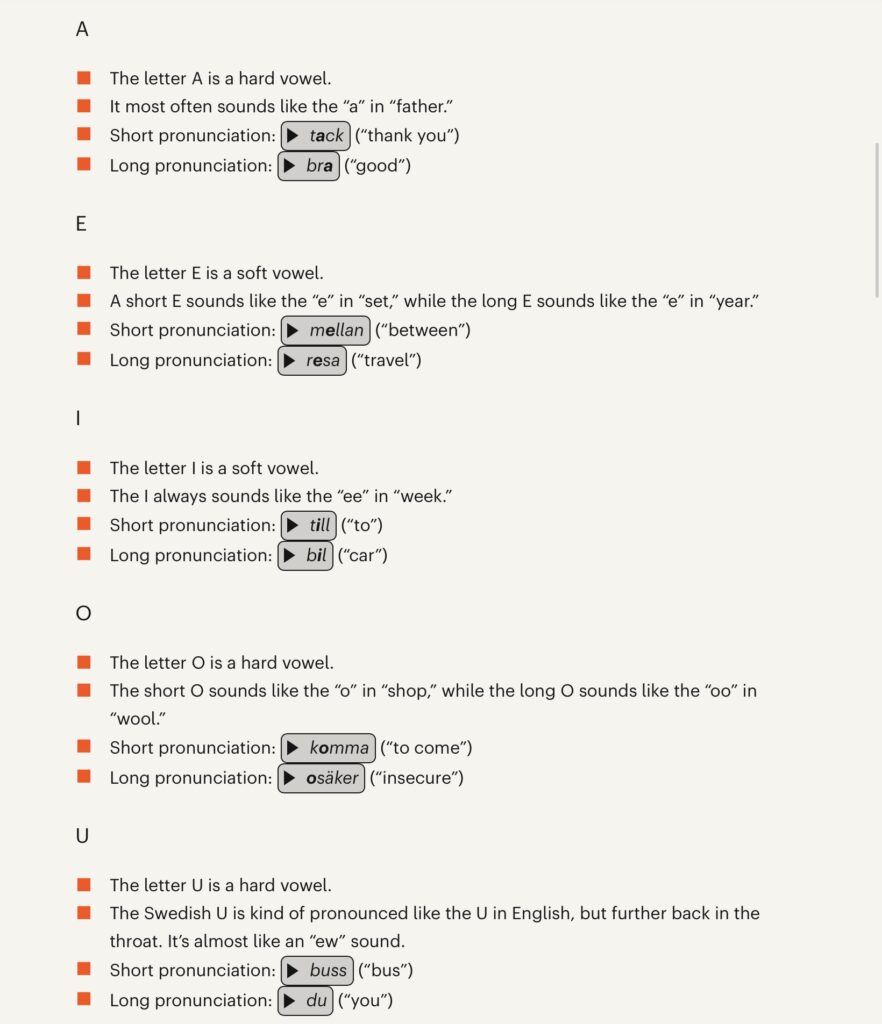
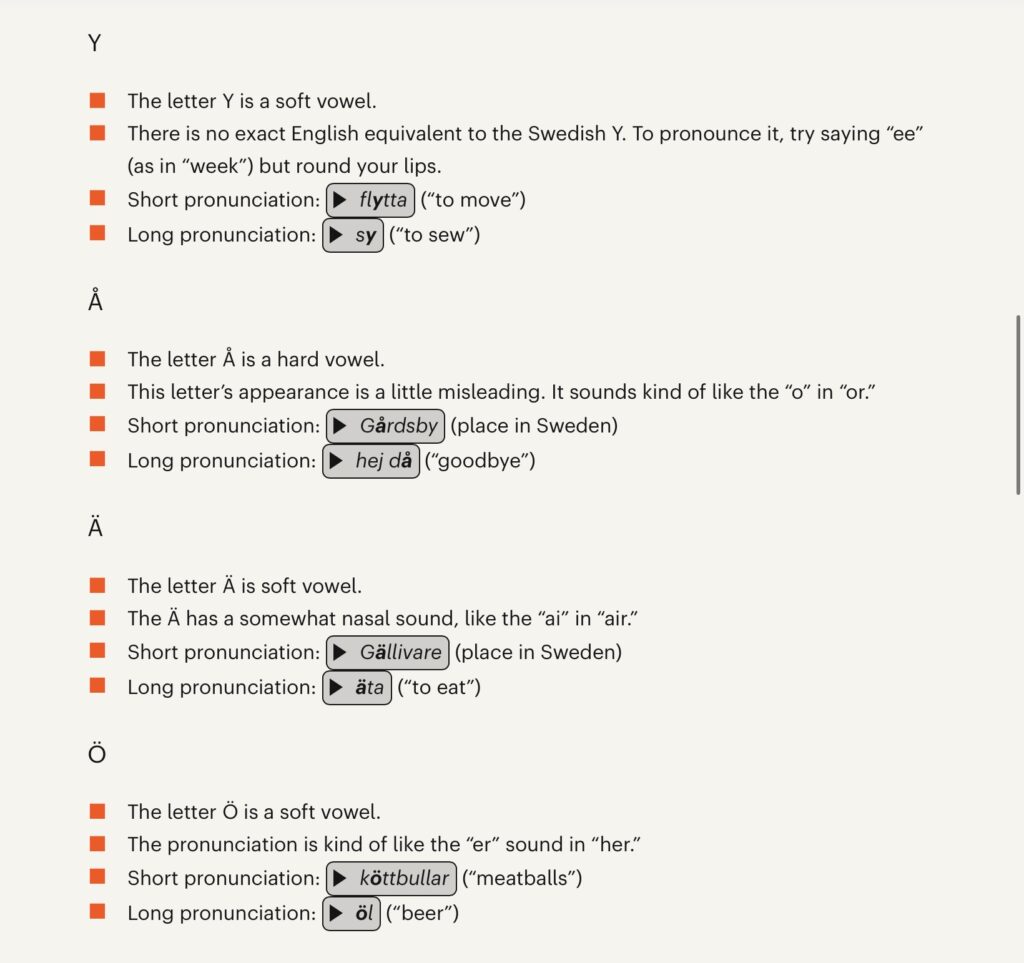
Back to the phonics thing… as part of our PDPP course load, my cohort is currently taking a course in reading. We’ve talked extensively about how to teach phonological awareness, phonemic awareness, and skills like word attack to early primary students. Here’s what I found on the web about Swedish letter sounds:
I also looked at an article by a Babbel contributor about Swedish letter sounds – it was very helpful. Here is a short guide on how to pronounce the vowels in Swedish:
Welcome to my weekly reflection. This one is going to be a mish-mash of various musings on course content – I can’t pull out a particular theme to my thoughts from this week, so I figured I’d just put them all down together, stream-of-consciousness style (bonus: that way, you can tell that I haven’t used AI to write this reflection!).
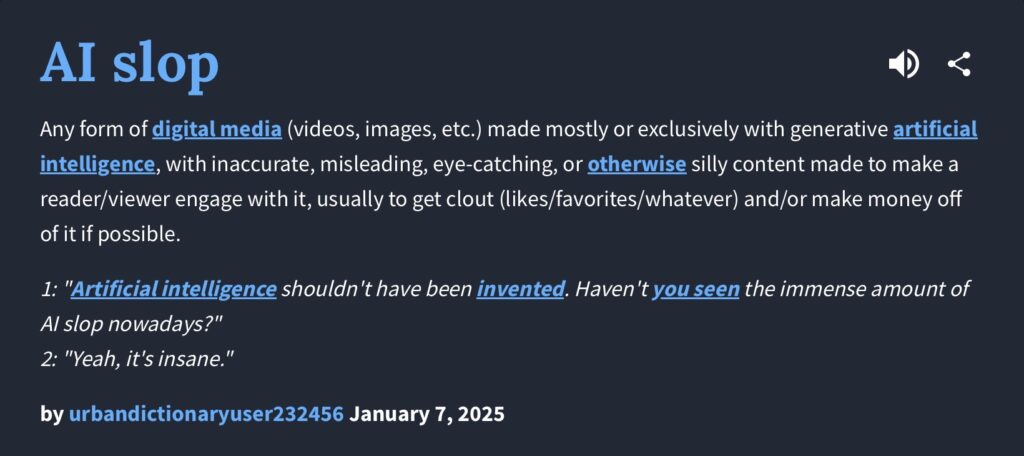
Urban Dictionary definition of AI slop
First, I’m still kind of reeling from our discussion about the potential environmental impacts of generative AI. I found it really interesting hearing what generative AI chatbots had to say about the environmental impacts of their servers. This felt kind of dystopian – I’m picturing a culminating scene in a sci-fi movie. Maybe the protagonist is about to shut down a chatbot’s server, but the chatbot has gained enough sentience to fight to stay alive by lying to people. I obviously don’t believe that Gemini and ChatGPT are lying about the extent of their environmental impacts. However, is it far-fetched to assume that the information AI chatbots provide on their carbon footprints might be an underestimate? It would make sense for these chatbots to be programmed to purvey a favourable view of AI – that would be good for business. It was interesting that when Randy asked various chatbots bout their environmental impact, they highlighted the other household appliances that take up water and electricity. I might be getting a bit too critical here, but… Anyways, I’m much more inclined to believe the research out of Western University that Nathan shared last week.
Side note: book recommendation
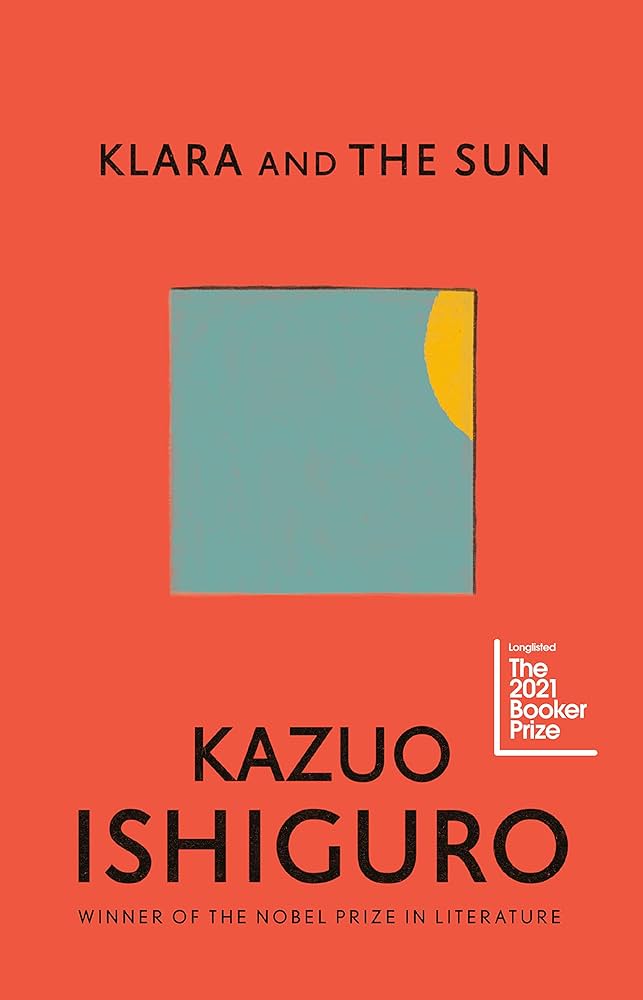
Speaking of sentient AI, I strongly recommend Kazuo Ishiguro’s novel, Klara and the Sun. I think it’s a great read for teachers. It takes place in a near-future world where wealthy children have AI companions to help with their social, emotional, and cognitive development. Klara and the Sun explores questions like, “What does it mean to love?” And “Will AI ever be able to replicate human emotions?” And like much of the science fiction and dystopian genres, it grapples with the consequences of unchecked technological innovation. 5 stars from me! And I believe it’s under 200 pages, making it tackle-able over reading break!
2021 Booker Prize winner, Klara and the Sun by Kazuo Ishiguro
I am glad that researchers are narrowing in on the impacts of AI on natural resources and ecosystems. I wonder what the challenges of studying AI might be. I imagine that it is exceedingly difficult to conduct rigorous academic research into a field that is shifting so rapidly. I remember trying out ChatGPT in December 2022. My roommate at the time was studying software engineering, so I had an “in” … I feel like I was slightly ahead of the curve in terms of testing out and adopting generative AI. The GPT-5 series we have today is a COMPLETELY different beast than ChatGPT 3-4 years ago. It wasn’t until recently that generative AI could search the web and incorporate accurate and up-to-date information. Even in the past few months, the technology has taken leaps and bounds. It must be difficult to pin AI down and study it – I talked about this in a reflection for my Language and Literacies class, which you can check out below. We had to read a fantastic article by Nomisha Kurian about conversational AI, mental health chatbots, and children’s literacy. Worth a skim, especially for future teachers!
“AI’s Empathy Gap” by Nomisha Kurian
My most common thought while reading this week’s article was “What?!,” closely followed by “Oh my goodness, society is doomed.” Nomisha Kurian clearly outlined the risks of unchecked conversational AI for children, using various examples that terrified me. What’s scarier is that as Kurian said, “conversational AI is a click away” for kids everywhere – even those who try to avoid it, because the first thing that comes up when you make a quick google search is the Google AI overview.
Conversely, though, I think it’s important to recognise that conversational AI has made leaps and bounds since the failure of Microsoft’s chatbot, Tay (2016), and the countless other examples shared in the article. The example about the 12-year-old experiencing sexual abuse (and the ridiculously inappropriate response from the chatbot) is from 2018, which may only be eight years ago, but so much has changed even in the past year! ChatGPT 4.5 passed the Turing Test in April 2025, when 73 percent of human judges in a UC San Diego study believed it was human. The development of conversational AI is outpacing the research surrounding it – it must be so difficult for academics like Nomisha Kurian to study AI considering that once their work gets approved/published, it might not be accurate – or maybe even obsolete! The responses that ChatGPT, Gemini, and other conversational AI models generate today are typically indistinguishable from information or advice given by a human – although as Kurian outlined, holes in AI’s accuracy appear when it comes to providing empathetic and contextual responses to emotional disclosures.
I think that today, the greatest issue facing children who engage with conversational AI won’t be blatantly inappropriate responses, but responses that are remarkably human and almost correct. I really liked how Kurian summarised it in their section on “transparency and authenticity.” We need to make it clear to children that even though it might feel like their interacting with another person, chatting with AI is not the same as connecting with a human. This starts with education – what is AI? How does it work? Etc. We need to remind our students that AI responses cannot substitute human interaction, and to encourage them to reach out to real people if they need help.
People on my social media feeds have been talking about using ChatGPT as a therapist, which, for lack of better language, really freaks me out! Here’s a link to a TikTok video about ranting to ChatGPT (because apparently linking TikTok videos is just something I do in these reading responses now!): https://vt.tiktok.com/ZSUusRQjT/.
I think that this is so dangerous! Even if you overlook the fact that AI can occasionally misinterpret a prompt and provide wildly harmful or unhelpful responses, there’s still the issue with conversational AI being designed to be agreeable. I think that’s a big danger with the personalisation aspect of AI – it tells you exactly what you want to hear. I’ve tried using ChatGPT to solve math problems, and if I say, “Wait, isn’t the answer 5?,” it’ll spit back an apologetic response ensuring me that I must be right, and making up reasoning for my answer, even if I was totally wrong with 5. If we take this same concern and apply it to someone’s personal problem, ChatGPT will typically unequivocally take their side and maybe lead them into an echo chamber/spiral of sorts. Scary!
To connect back to the article, I strongly disagree with the idea of mental health “counsellor” or “therapist” style chatbot for children. I can concede that we have a shortage of mental health professionals and that there are significant barriers to getting help (e.g., long wait lists for assessments, insurance). However, AI absolutely cannot replace therapy, especially for children and youth. Kids with mental health problems are some of our most vulnerable people – and those in the direst need of real human connection. We need to put strong guard rails up on all forms of conversational AI when it comes to mental health – chatbots should not be counselling us, they should be reiterating that they are unable to provide advice and pointing users toward the services that they need. To summarise, that’s my main takeaway from this week’s article – we (teachers, parents, and policymakers) need to REGULATE children’s access to conversational AI, and lobby for software companies to put safeguards in place to protect our kids from falling victim to the “empathy gap.”
– SUmmary of my reflection on conversational AI chatbots for children (EDCI 301)
CBC – environmental impacts of AI (video)
A great video for kids.
To close, rapid fire – here are my thoughts on generative AI, its environmental impact, and our free will:
Do we have any choice about using GenAI?
Yes and no. Yes, we can actively choose whether we put our work into Gemini or MagicSchool or ChatGPT – no one is making you do that (except, maybe this class when we did the AI Workbook – haha!). However, I do think we as teachers have a duty to understand how AI works and how our students are being exposed to it. I want to prepare my students for safety and success in our increasingly artificially intelligent world, and I would be doing them a serious disservice by shuttering AI out of my classroom.
Can we avoid its use?
Increasingly, no. AI is pervasive, and even if we’re not using it, someone else is – whether that be our colleagues, administrators, students, or the sources that we trust to get our information from (news outlets, academic articles, even search engines with that annoying “AI Overview” function).
Will the tech giants solve the power and water overconsumption?
My pessimistic answer is NO WAY! I can’t envision a world where public concern/outrage about AI’s environmental impacts will outweigh the profit motive for tech companies. People know that AI is using so much water and power, but that’s not stopping us. Plus, in big affluent cities in the Global North, we aren’t seeing the impacts of AI servers directly. To make tech giants take real action to mitigate their environmental impact, people would need to mobilize by boycotting AI. And I don’t see that happening, because (a) generative AI is so convenient, good for productivity, and fun, and (b) most AI users aren’t seeing the negative impacts of their AI use in a meaningful way.
That’s all! I’m excited to continue my learning journey about AI!
For this week’s reflection, I want to discuss universal design for learning (UDL) in the context of educational technology, especially generative AI. I am already quite familiar with UDL – from my background as an educational assistant, as well as from our PDPP courses thus far (e.g., ED-D 301: Learners and Learning Environments). So, what we’ve been covering is mostly review / consolidation. That is, except for the ways that we can use new tech to UDL-ify our practice. I’ve been loving considering UDL in the context of AI, so, the theme of this reflection is…
Employing AI to reach students of diverse abilities and interests
I’ve previously mentioned that I am SUPER EXCITED about the potential UDL applications of generative AI. Differentiating lessons and materials can be a huge hurdle, especially for early career teachers. I want to be able to meet every student where they’re at, and provide the optimal challenge that they need to learn and thrive. I think that AI could help.
I thought it would be a fun exercise to take the UDL checklist that was linked in this week’s course materials, and brainstorm/test out ways that generative AI could be used to fulfill it. I also included some prompts you could use as inspiration.
Universal Design for Learning Checklist
Make Expectations (objectives, rubrics, grading) explicit from the start
Use AI to rewrite objectives in student-friendly language
Example: Ask ChatGPT, Claude, or Gemini, “Rewrite this learning objective in simple grade 3 student-friendly language”
Multiple means of engagement
Use AI to personalize activities and texts to student interests
Example: “Rewrite these math word problems to feature characters from the popular Netflix original, KPOP Demon Hunters”
Multiple means of representation
Use AI to create concept maps, analogies, and story-style explanations. I recently discovered NapkinAI, which is great at creating visual concept maps (sometimes ChatGPT sucks at this – it still struggles with generating text and images together).
Example: “Explain photosynthesis three ways: a story, a diagram description, and a sports analogy.”
Include alternatives to the text (e.g. website, article, video, audio summary, or lower reading-level text
NotebookLM makes great podcasts/audio summaries from written texts. It could be a great resource for kids who struggle to decode or tackle big blocks of words.
In my AI Workbook assignment, I tried out using ChatGPT to translate a text into a lower reading level. This is an area where it thrives.
MagicSchool also has a text leveller tool.
Example: “Rewrite this article at a grade 4 reading level and include key vocabulary definitions.”